7 car games for kids ages 6–10, with no supplies
For a car game you can start without packing anything, try three clues, Pair Patrol or an imaginary shop. These seven passenger games need no phone, paper or purchase. Each has an example, an easier way in and a small optional challenge.
By Brightamble Press · Published September 18, 2026 · Updated October 17, 2026
Read the rules before departure or let an adult passenger explain them. The driver stays focused on driving. Stop after a few turns, change the game or leave some quiet time; there is no need to keep everyone playing.
Choose by the moment, not the mile
- Two passengers want to chat: start with three clues or the imaginary shop.
- The view offers something interesting: try Pair Patrol. Use only what is easily visible from a safely seated position.
- It is dark or the view is blocked: invent a word, a parcel or a place. None depends on spotting a particular landmark.
- One child wants to play alone: imagine a souvenir or a shop. Save any drawing for later.
Seven games with a clear place to stop
1. Three clues, one thing
Choose a familiar object and give three clues without naming it. Another passenger gets one guess, then you reveal it and swap. Try: “I have a handle. I open overhead. I help keep rain off.” An umbrella fits. Accept another answer if it fits all three clues.
Make it easier: name the category first, such as something you carry. Add a challenge: give clues without describing its color. Finish: three turns each.
2. Pair Patrol
Choose a feature such as round, tall or striped. Find two different things that share it: a wheel and a round sign, for example. The next passenger picks a feature. There is no race and no leaning or turning around to find an answer.
Make it easier: choose a familiar shape. Add a challenge: find things with the same shape but different uses. Finish: four pairs, or sooner if the view offers little. Imagine a pair when you cannot see one.
3. The imaginary shop
One passenger runs a pretend shop; another is the customer. The customer asks about three items, and the shopkeeper invents what they do. A cloud umbrella could make a patch of shade; a whisper jar could hold a secret sound. Swap roles after the third item.
Make it easier: choose a shop theme, such as things for a giant. Add a challenge: explain one surprising drawback of each item. Solo option: imagine both sides of the conversation.
4. A new word
Invent a word, say what it means and use it in a sentence. “Teadoze” might mean a tiny nap for a sleepy teapot: “The teapot took a teadoze.” The word can name something real or imagined.
Make it easier: combine two familiar words. Add a challenge: let another passenger use the new word in a different sentence. Finish: one word each. No spelling test is needed.
5. Mystery parcel
Imagine an object inside a parcel. Give clues about its shape, use and size. “It is long and thin, it makes a mark, and it fits in a hand” could be a pencil. Allow one guess, reveal it and swap. Say before the clues if your object is imaginary.
Make it easier: use something familiar from home. Add a challenge: imagine an object that could fit inside a matchbox. Finish: two parcels each.
6. Friendly tour guide
Welcome visitors to an imaginary place in two sentences. “Welcome to the Museum of Lost Socks. Every sock has its own tiny room.” Another passenger asks one question, then becomes the guide.
Make it easier: start with a library, park or shop. Add a challenge: explain a rule visitors must follow and why. Finish: one tour each.
7. A souvenir nobody can buy
Invent an impossible souvenir and explain how you would carry it home. A pocket-sized echo might travel in a padded envelope. A moonbeam might need a very dark box.
Make it easier: choose one ordinary thing and change its size. Add a challenge: decide who would enjoy it and why. Finish: one souvenir each, or two ideas for a solo player to choose between.
Can a six-year-old and a ten-year-old play together?
Use the same prompt with different amounts of detail. A child who wants help can give one clue or finish an example started by another passenger. A child who wants a harder version can explain a reason or add a constraint. Reading confidence and interest matter more than a fixed age rule.
Take turns choosing the game. Shared answers work well here; nobody needs to keep score or finish at the same pace. If the conversation becomes too busy, switch to an idea from our quiet activity guide.
When you want a pencil choice as well
A spoken idea can become a drawing at a stop. The impossible souvenir can go into the free pack's Pocket Museum. A tour guide could become the main character in a four-picture story. Plain paper works too.
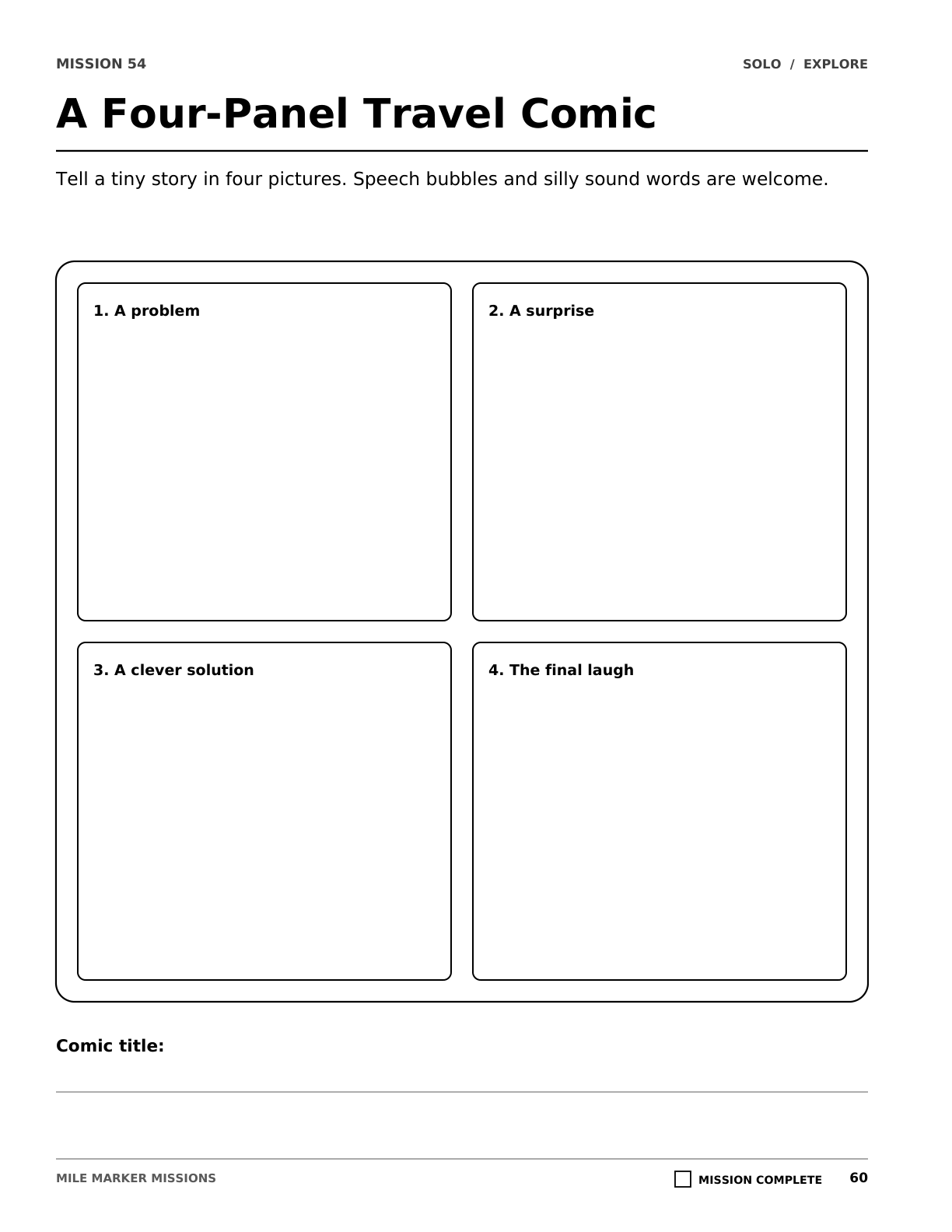
For more activities already printed and bound, Mile Marker Missions has 88 activities across 100 black-and-white pages for ages 6–10. The 8.5 × 11-inch paperback includes puzzles, drawing, looking games and trip memories. Bring a pencil; younger readers may want help.
Check current price and delivery on Amazon. These choices do not promise a quiet or boredom-free journey. For supplies, see the five-item activity kit checklist.